Log in
A+ A A-

E.Tsiliopoulos

Website URL:

Author and philosopher Stelios Ramfos has died at the age of 87.


He was born in Athens in 1939 and studied at the Law School of the University of Athens. In 1965, he moved to Paris, where he continued his studies in philosophy. From 1969 to 1974, he taught at the University of Vincennes before returning to Greece, where he settled permanently.

Over the course of a prolific literary career spanning several decades, Stelios Ramfos devoted himself systematically to questions of philosophy, religion, psychology, history, and Greek identity. A central focus of his thought was the interpretation of Hellenism and the effort to understand the influence exerted by Byzantium and the Orthodox tradition on the formation of modern Greek consciousness.

Throughout his long intellectual journey, he sought to bring together ancient Greek philosophy, the Christian and Patristic tradition, and modern Western thought in an effort to identify the deeper characteristics of Greek society. At the same time, his contributions to public debate on politics, education, religion, and the relationship between the individual and the collective frequently sparked vigorous discussion and controversy.

He was an exceptionally prolific author, publishing more than 30 books and scholarly studies. For many years, he also delivered lectures and organized series of public seminars that attracted large audiences. His works ranged from studies of ancient Greek thought and Orthodoxy to examinations of the collective imagination and the psychological roots of contemporary Greek society.

His influence was not confined to academia or writing. For decades, he participated actively in public discourse through lectures, interviews, and public interventions, often advancing incisive views on both the shortcomings and the potential of Greek society.

His death brings to a close an important chapter in modern Greek intellectual life, leaving behind an extensive body of work and a body of thought that—whether it inspired agreement or strong disagreement—consistently sought to place the question of Greek self-understanding at the center of public reflection.

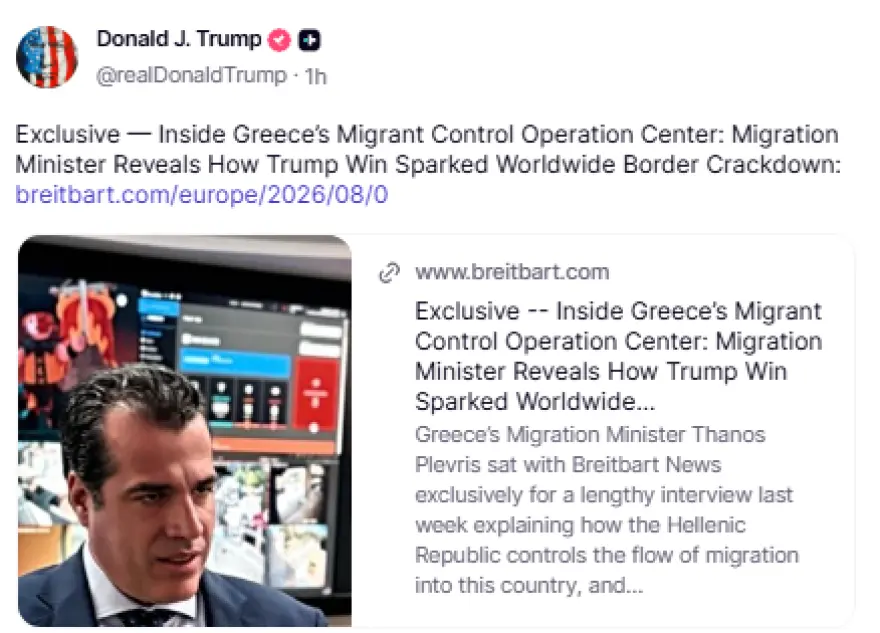
Trump reposted Thanos Plevris’ Breitbart statements on migration

US President Donald Trump has shared on his Truth Social account an interview given by Greece’s Minister of Migration and Asylum, Thanos Plevris, to Breitbart, in which he discusses the tightening of Greek and European migration policy and credits Trump’s return to the White House with playing a significant role in that shift.

Trump’s decision to repost the Greek minister’s interview is particularly noteworthy, as Plevris speaks warmly of the US president and argues that his re-election in 2024 helped change the political climate surrounding migration not only in the United States but across Europe.

The Migration Minister describes himself as “an admirer of Trump” and says the most significant change brought about by his return to the US presidency has been the new approach to illegal migration.

According to Plevris, countries including Germany, France, the Netherlands, Denmark and Sweden have all moved towards stricter migration policies as public pressure for stronger border controls has increased.

‘The message from the public is: Enough’

Plevris says a similar trend is evident in Greece, citing opinion polls which, according to him, show that a large proportion of the public either supports the government’s migration policy or wants even tougher measures.

“The message from our citizens is clear: enough,” he says.

At the same time, he presents the Mitsotakis government’s strategy as one that is “firm but fair”, with its main objectives being to reduce irregular arrivals and increase returns.

Fewer arrivals and more returns

In the interview, the minister refers to the impact of the new legislation, claiming that migration flows to Greece have fallen significantly.

Specifically, regarding the route from Libya via Egypt, he says that 3,200 irregular arrivals and just 69 returns were recorded in the first half of 2025, while during the same period in 2026 arrivals fell to 802 and returns rose to 330.

According to Plevris, overall migration flows to Greece have fallen by around 70% over the past year, while returns have increased.

He attributes this development, among other factors, to the detention of individuals who do not qualify for refugee status, stricter action against those who remain in the country illegally after their asylum applications have been rejected, and the expansion of voluntary return programmes.

Evros border fence and the message on border security

The minister also highlights the Evros border fence, describing it as a key tool in limiting irregular crossings along Greece’s land border.

He recalls the 2020 border crisis, when thousands of people attempted to cross en masse from Turkey into Greece, arguing that the fence, together with the presence of the military and police, played a decisive role in managing the situation.

He also stresses that Greece’s borders are the external borders of the European Union.

Reference to the US and Trump

Plevris argues that the policy shift in the United States following Trump’s return to office also made it easier for European governments that were already seeking a tougher stance on migration.

He adds that Greece and the United States are now cooperating in the field of asylum, exchanging best practices.

Plevris also notes that Greece began implementing a stricter migration policy when Kyriakos Mitsotakis took office in 2019, contrasting the current situation with that of 2015, when, as he points out, around one million people passed through the country.

Donald Trump’s decision to highlight the interview on Truth Social adds further political significance to the Greek minister’s remarks, particularly his comments about the influence that, in his view, Trump’s return to office has had on the international debate over migration.