
Eleanna Finn
- Written by Yanna Darilis
- Published in Greek of the Week

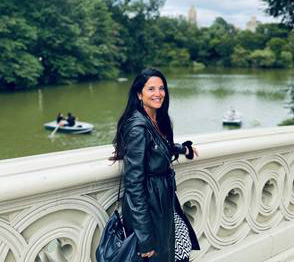
Actress Eleanna Finn spoke to New Greek TV about her journey from Greece to the United States, describing it as a leap driven by both ambition and self-discovery. Trained in Athens and deeply influenced by Greece’s rich storytelling tradition, Finn felt compelled to test herself on a larger, global stage. Arriving in America brought an immediate reality check, the industry moved faster, the competition was relentless, and success required more than talent.
Starting over in a new country meant rebuilding her career and confidence from the ground up. Yet the experience also revealed her resilience, teaching her that persistence, emotional stamina, and dedication to the craft are as vital as ability. Through setbacks, breakthroughs, and moments of doubt, Finn says the journey ultimately strengthened her identity as both an artist and a storyteller shaped by her Greek roots.
NG: What first inspired you to leave Greece and pursue an acting career in the United States?
EF: I always felt a pull toward something bigger than what felt immediately accessible to me. Greece gave me my foundation, my training, and my love for storytelling. But I wanted to challenge myself in an environment where the industry operates on a global scale. Moving to the U.S. wasn’t just about career ambition — it was about growth. I wanted to see who I could become outside my comfort zone.
NG: When you arrived in America, what was the biggest reality check you faced about the industry?
EF: The scale and speed of everything. The competition is intense, and no one is waiting for you to “arrive.”
I loved that energy—I felt like I truly belonged. Coming from Athens, everything here moved fast in a way that felt exciting, whereas back home, sometimes it felt like I was moving too quickly or the city was moving too slowly.
Here you have to create your own momentum constantly.
I realized very quickly that talent is just the baseline — resilience, consistency, and emotional stamina are equally important.
NG: How difficult was it to start over professionally in a new country, and what did that experience teach you about yourself?
EF: Starting over was humbling. In Greece, I had context. In America, I was unknown. It forced me to rebuild not just my résumé, but my confidence. I learned that I’m far more adaptable than I thought — and that courage isn’t loud. Sometimes it’s just quietly continuing when no one sees the effort.
NG: What was your breakthrough moment?
EF: My breakthrough wasn’t a single dramatic moment — it was a combination of experiences that made me feel like I truly belonged here. Walking onto a set for the first time and realizing I was a working actress in this country was huge, but so were specific projects that shaped my path: performing Edith in Anna Frank, sharing the stage in the Broadway-bound GBNY production with stars like Arielle Jacobs, and working closely with Tony Award-winning producers such as Brian Spector and Van Dean, president of Broadway Records. I also collaborated on What’s Going On Tonight with Krone Films and Steven Krone, a prominent Hollywood film and television producer and former President of Village Roadshow Pictures. Bringing iconic Greek voices like Callas and Vembo to life reinforced my artistic identity even further. These experiences gave me confidence, visibility, mentorship, and the sense that my work could stand alongside the best in this industry.
NG: Were there moments when the struggle felt overwhelming, and how did you push through those times?
EF: Absolutely. There are moments of deep doubt — especially being far from family and your support system. What helped me was returning to the craft itself. When I focus on the work — training, preparing, improving — it grounds me. Discipline carries you when motivation fades.
NG: What would you describe as the hardest moment in your journey so far?
EF: The hardest moments in my journey are often quiet ones—when opportunities almost happen and then fall apart, forcing you to confront how much you want this and whether you’re willing to endure uncertainty.
That for me was the pandemic. I had to take any work I could find— health clinics, supermarkets—just to survive. The loneliness and uncertainty were brutal; I felt completely estranged and stranded. But enduring that period taught me resilience, persistence, and the emotional stamina that I rely on in my career today.
NG: On the flip side, what has been your happiest or most meaningful moment since coming to the U.S.?
EF: Being on set for Only Murders in the Building as a stand-in for Selena Gomez, and then being kept the next day as talent in the trailer, meeting my icons like Martin Short and Steve Martin, and seeing how they work was unforgettable.
The first time I saw my name on a Playbill and Broadway world was a moment that crystallized the journey, gave me full goosebumps, and a profound sense of arrival.
Performing in the British musical Always Young, I remember lying on stage every night, looking up at the theatre lights, seeing my younger self in that moment—full of dreams, proud of how far I’d come from Crete to this stage.
NG: How did it feel the first time you booked a project that made you feel truly validated as an actress?
EF: It felt like confirmation that the risk was worth it. Not because of external approval, but because it showed me I could compete in this market. That validation was deeply personal.
NG: In what ways has your Greek heritage shaped your approach to acting?
EF: Greek culture is emotional, expressive, and rooted in storytelling—we are the birthplace of theatre.
Growing up on the island of Crete, I was surrounded by rich traditions, music, and stories that instilled a deep sense of rhythm, passion, and humanity. That depth and intensity naturally inform my work.
I carry a strong sense of history and cultural identity into every character I portray.
NG: Did you ever feel pressure to change who you are to fit into the American entertainment industry?
EF: There’s always subtle pressure — accents, typecasting, expectations. But I’ve learned that what makes you different is often your greatest strength. I’m not interested in erasing my identity to fit in. I want to expand the definition of who gets to belong.
NG: What personal sacrifices have you had to make?
EF: Distance from family has been the biggest sacrifice—missing milestones, holidays, and simply being present in everyday moments. There were summers I couldn’t be home due to visa renewals or other technicalities, and I missed having my loved ones at premieres, including my own family. Financial instability in the early stages added another layer—investing in classes, headshots, and visas required long-term faith and persistence. All of these challenges tested my commitment, but they also strengthened my resilience and dedication to my craft.
NG: How has rejection shaped you?
EF: Rejection has strengthened my emotional endurance. At first it feels personal. Eventually, you understand it’s part of the ecosystem. It taught me not to attach my self-worth to outcomes.
NG: What have been some of your most rewarding professional successes so far?
EF: Every booking that came after a long audition process feels rewarding. Also, creative collaborations where I felt creatively stretched and trusted.
NG: Can you tell us about your latest projects and what drew you to those roles?
EF: Right now, I’m drawn to layered female characters—women who are complex, flawed, strong, and vulnerable at the same time. For example, in Blanche DuBois, I was drawn to the intensity and depth of her role, exploring emotional fragility and hidden strength.
Another project, playing Sally, a young woman navigating bullying, allowed me to dive into the psychology of resilience and vulnerability, bringing empathy and truth to her experience. I’m always drawn to stories that explore power dynamics, human emotion, and the inner life of women.
NG: What kinds of stories or characters are you most interested in exploring right now?
EF: Psychological dramas, morally complex narratives, and characters navigating identity between cultures. I’m fascinated by duality — strength and fragility coexisting.
NG: How do you define success today compared to when you first arrived?
EF: When I first arrived, success meant visibility and credits. Now, it means sustainability — building a career with integrity, artistic growth, and longevity.
NG: What new goals are you setting for yourself?
EF: I want to work on projects that travel internationally and collaborate with filmmakers who value strong character-driven storytelling. Expanding into higher-level productions is a goal.
NG: Are there creative risks you’re ready to take now that you weren’t earlier?
EF: Yes. Earlier, I wanted to prove myself. Now, I’m more interested in challenging myself — even if that means choosing roles that are less “safe.”
NG: Do you see yourself expanding into producing or writing?
EF: Eventually, yes. I’m very interested in developing stories that bridge Greek and American perspectives. Producing would allow me to shape narratives from the ground up.
NG: What advice would you give to other Greek or international artists who dream of building a career in the U.S.?
EF: Be prepared for a marathon, not a sprint. Protect your mental health. Invest in your craft constantly. And remember — your uniqueness is not an obstacle. It’s your edge.
NG: When you look back on your journey so far, what are you most proud of?
EF: I’m most proud that I didn’t quit. That I stayed when it would have been easier to go back. Reinventing yourself in another country takes courage — and I honor that in myself.

Latest from Yanna Darilis
- The Hellenic Initiative Raises Over $1 Million for Greece at Landmark Chicago Events Featuring Konstantinos Argiros
- Magna Graecia: The Forgotten Think Tank of Classical Greek Civilization
- The Hellenic-American Chamber of Commerce organized the Vasilopita 2026 in collaboration with 21 Hellenic-American and Cypriot-American organizations and 5 youth organizations
- U.S.- Greece Strategic Partnership Takes Center Stage at Capital Link Forum in New York
- "Kapodistrias- The Governor: Sacrifice Leads to Freedom” by Yiannis Smaragdis, Premieres in New York