The first female figures on pedestrian crossing lights have made their appearance in Nicosia, as part of an initiative aimed at promoting gender equality in public spaces.
Hellenic Organization of Cultural Resources Development (ODAP) in partnership with "The Master Miller", has launched "Charisma," an extraordinary collection of four extra virgin olive oils crafted from olive trees growing at Greece's most iconic archaeological sites: Ancient Olympia, Delphi, Ancient Messini, and the Acropolis of Athens.
A Vision Rooted in Cultural Heritage
At the 2021 launch of the collection's first products, Minister of Culture Lina Mendoni articulated the initiative's profound vision: "Following the opening of selected archaeological sites and museums to gastronomic events showcasing local primary production, ODAP is launching a new initiative: producing agri-food products that originate from the archaeological sites themselves and are directly linked to their natural and cultural landscape... With distinctive packaging, this olive oil becomes a unique cultural artifact—an exceptional souvenir for visitors, both Greek and international, to our archaeological sites and museums."
Varieties that Whisper Stories of Centuries
Traditional local varieties—including Koroneiki from Olympia and Kalamata olives—contribute their authentic signatures to each expression, while PDO and PGI certifications guarantee origin and quality.
Through meticulous cultivation and traditional cold-press methods, the essence of Greece's most significant archaeological landscapes is captured in bottles that deliver an authentic taste of the nation's cultural legacy.
Konstantinos Papadopoulos, Founder & CEO of The Master Miller, explains: "The olive groves surrounding these sacred sites have witnessed millennia of history, and their fruit carries that legacy. These are not merely premium olive oils—they are liquid monuments to Greek heritage, bottling the spirit of places that shaped Western civilization."
International Recognition
The collection's flagship product, "Charisma of Zeus," has already garnered international acclaim, winning gold medals at prestigious competitions in New York and Athens in 2024 and 2025. Its high polyphenol content and exceptional organoleptic profile make it equally suited to everyday cooking and the most refined gastronomic creations.
More Than a Culinary Product
The "Charisma" Archaeological Sites Collection transforms each meal into a cultural experience—every dish into a journey through time, where culture itself becomes a flavor to be savored. It represents a pioneering fusion of Greece's archaeological treasures with its renowned tradition of olive oil excellence.
AVAILABILITY
The "Charisma" Archaeological Sites Collection is available exclusively at “ Hellenic Heritage ” museum shops located in archaeological sites and museums across Greece and will soon be available online at hhstore.gr .
Product Details:
Format: 250ml bottles
Price: € 18
FOR MORE INFORMATION:
Hellenic Organization of Cultural Resources Development (ODAP) Email: This email address is being protected from spambots. You need JavaScript enabled to view it. Website: www.odap.gr
On the occasion of the recent anniversary of the United Nations the Permanent Representative, Ambassador Ms. Aglia Balta penned a vert poignant article entitled: "80 years of the UN: An Organization in constant evolution serving humanity",
After Diaporos, in Halkidiki, where three hotels are already planned to open in the coming years, Trizonia is the focus of investment interest, also a tiny, unknown to many islet in the Corinthian Gulf, where only a few families live in the winter and comes to life mainly in the summer.
Mitsotakis: The most ambitious modernization program in the history of the Armed Forces is underway
We still need to complete both the exterior and interior of the building so that it is fully aligned with what the exterior transformation symbolizes. Defending our homeland is an absolute and non-negotiable priority. The most ambitious modernization program in the history of the Armed Forces is currently underway. Over the next 12 years, committed resources will exceed €28 billion.
We
have already acquired upgraded Rafale and F16 Viper fighter jets, and soon F-35 aircraft. This gives the Air Force a strategic deterrent superiority. The Navy is being modernized with the Belharra frigates. All of this is happening while we are also advancing numerous unmanned systems. The Armed Forces are being strengthened and modernized like never before.
What Mitsotakis emphasizes is a dual understanding of defense: it is not limited to military strength but also extends to the cultural and historical heritage of the country. In other words, defending the homeland includes preserving its identity, values, and the memory of ancestors who sacrificed themselves for freedom.
Kostas Varotsos’ sculpture honoring the 121,000 fallen serves exactly as a visual and emotional symbol of this memory. It is a way to remember that the history and sacrifices of the past constitute a form of “power” in the sense of cultural and national cohesion.
If you want, I can also provide a brief analysis of the symbolism of this particular sculpture and how it fits into the narrative of the modernization of the Armed Forces.
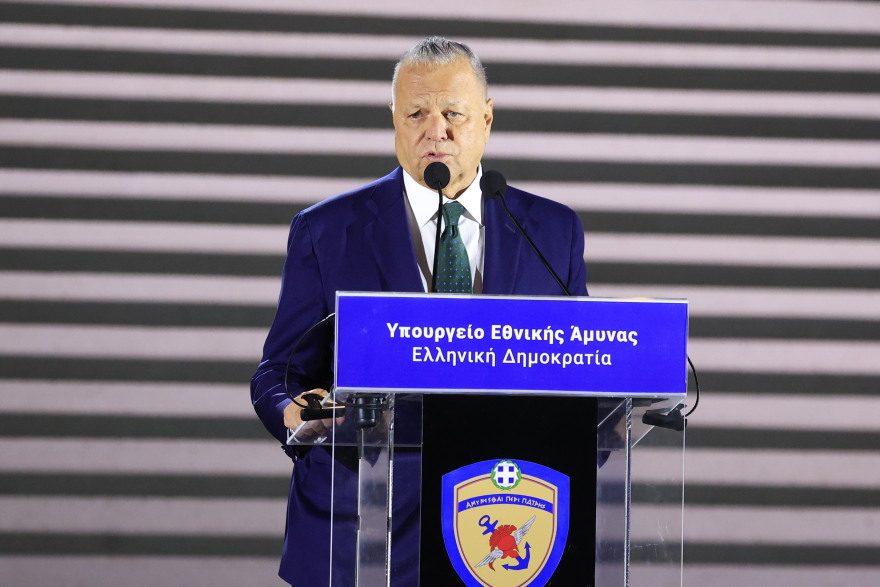
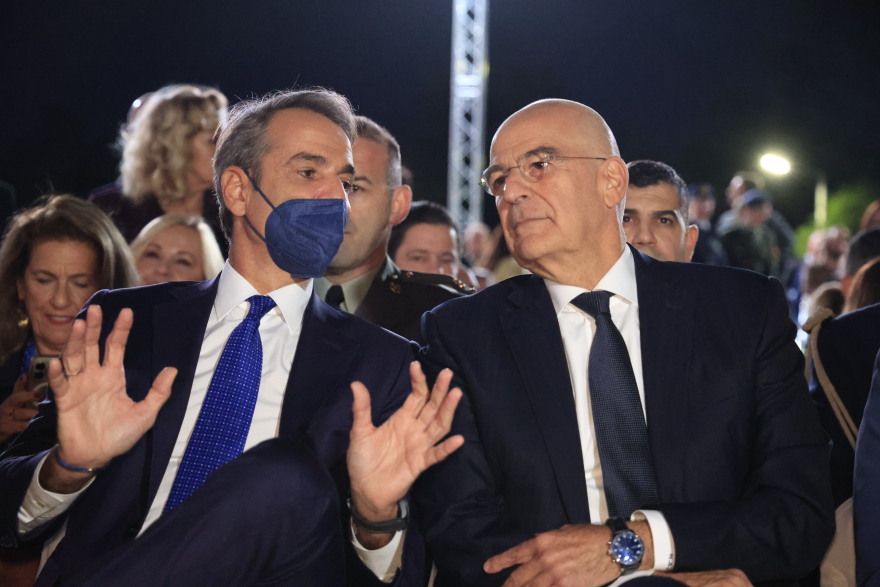
At the podium, the Minister of National Defense, Nikos Dendias
Dendias:
“The new appearance represents a change in the philosophy of the Armed Forces The evolution of an institutional building signifies change and progress. The new facade of the building reflects the new image of the armed forces. It marks the major reform of the Agenda 2030, through which we are implementing changes in structures. The new image is not merely an aesthetic intervention, but a symbol of adaptation to new conditions—a change in the philosophy of the Greek Armed Forces. We can now think beyond the ugly concrete box that the building had been for decades.”
“Greek Foreign Minister Nikos Dendias announced the launch of a competition for the design of the Unknown Soldier Monument, emphasizing its role as a symbol of national unity and shared historical memory. He stressed that the monument is not merely a work of funerary art but represents uplift and elevation. Its materials and form—the straight metal and vertical lines—evoke a sense of solidity and Doric simplicity, pointing toward the future, while also recalling the traditional fustanella and ancient Greek columns, thus connecting historical tradition with the present day.”
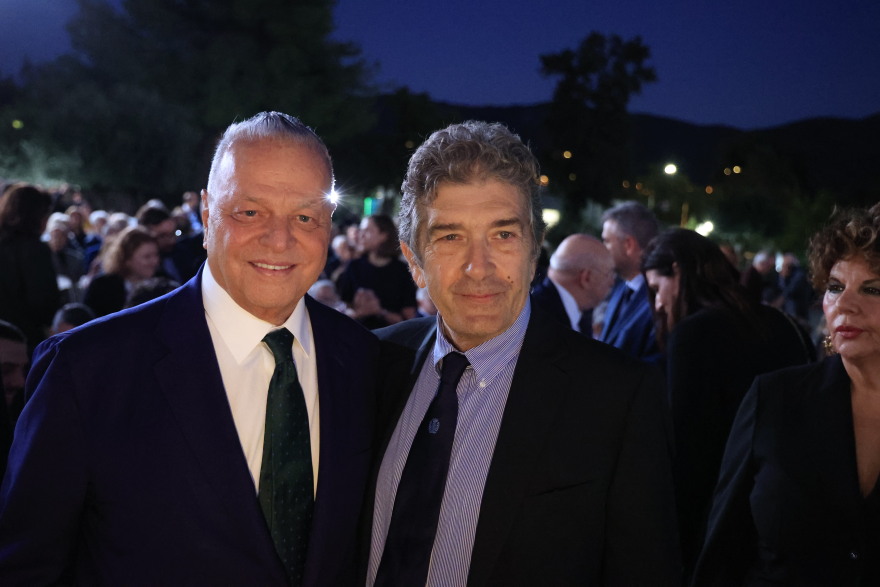
Evangelos Mytilineos
“The new command center was created by Greek hands. The new bioclimatic façade faces the 121,000 names of the fallen of the Nation. From here, it radiates across the entire territory—by land, sea, and air. I am proud because this command center was built by Greek hands.”
Architect Kostas Varotsos
“When the Minister first called me, I was anxious about what I would encounter — it was truly an experience for me. To my great surprise, a miracle happened. Everyone here at the General Staff embraced this effort. We all aimed to make a cultural proposal for Athens and, more broadly, for Greece.”
“They gave me the names of the 121,000 people who fell so that we could be here and do what we do. I didn’t want to place them in a grave; I wanted them to hover. I invite you, as you leave, to pass by the monument and see them. Only the military can show how important peace is, because the military knows what war truly means.”
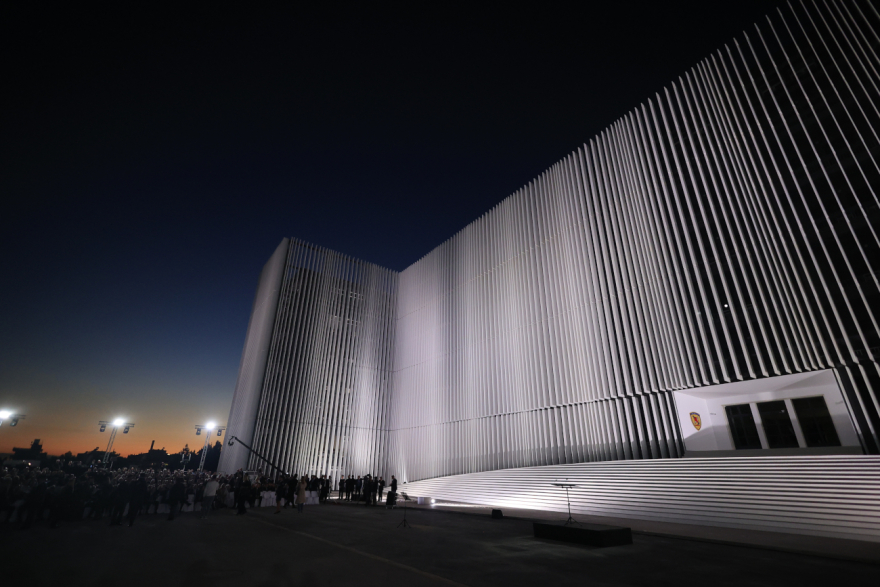
The project covers the southern façade, which spans 340 meters, with 730 vertical rows of white aluminum louvers, each 30.5 meters high. These are designed to improve the building’s thermal performance and provide a unified architectural identity.
The new façade is part of a broader architectural ensemble that includes the “Ark of National Memory” monument by sculptor Kostas Varotsos, which bears the engraved names of 121,692 fallen heroes from Greece’s national struggles.
“This building stands on Ancient Greek history with its folds. It is an open building, a bright building, and it does not hide anything. I want to conclude with a big ‘thank you’ to all the people who worked on these two projects. I want to thank the minister who took the risk of inviting me to carry out these projects.”
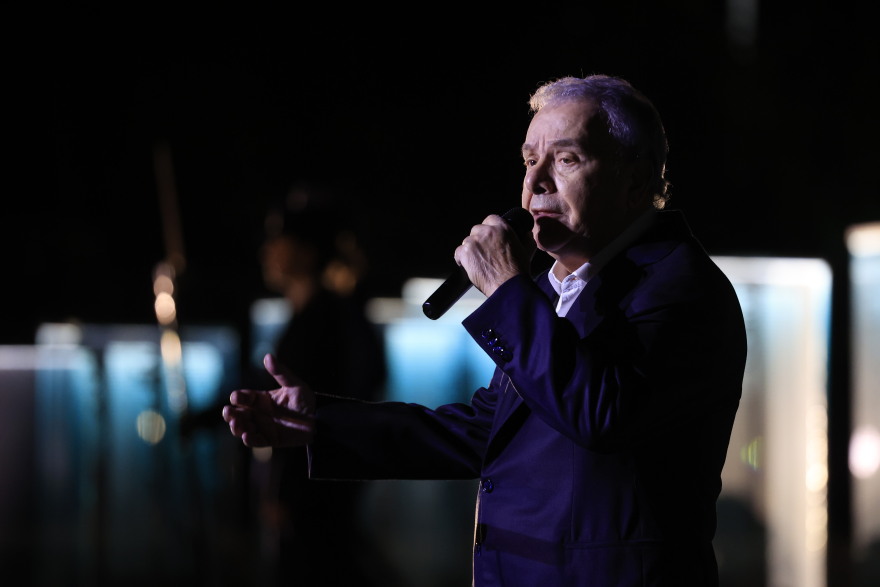
Manolis Mitsias performs “Pos na sopaso” (“How Can I Keep Silent”) — a song by Nikos Xylouris and Stavros Xarhakos, 1972.
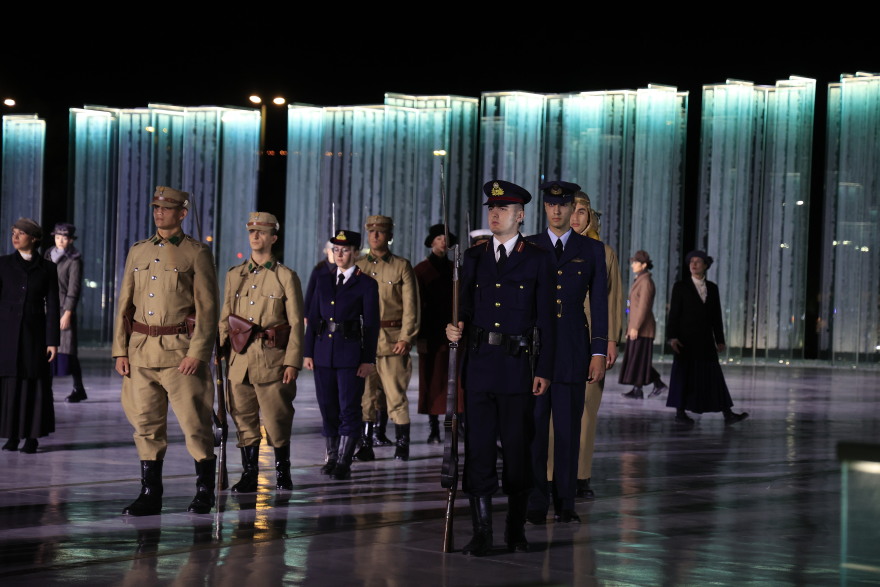
A new era has begun for the MInistry of National Defense, as the new bioclimatic façade of its central building on Mesogeion Avenue is being presented today.
The transformation of this historic building, originally constructed in the 1960s, marks a significant step forward in the fields of architecture and environmental sustainability.
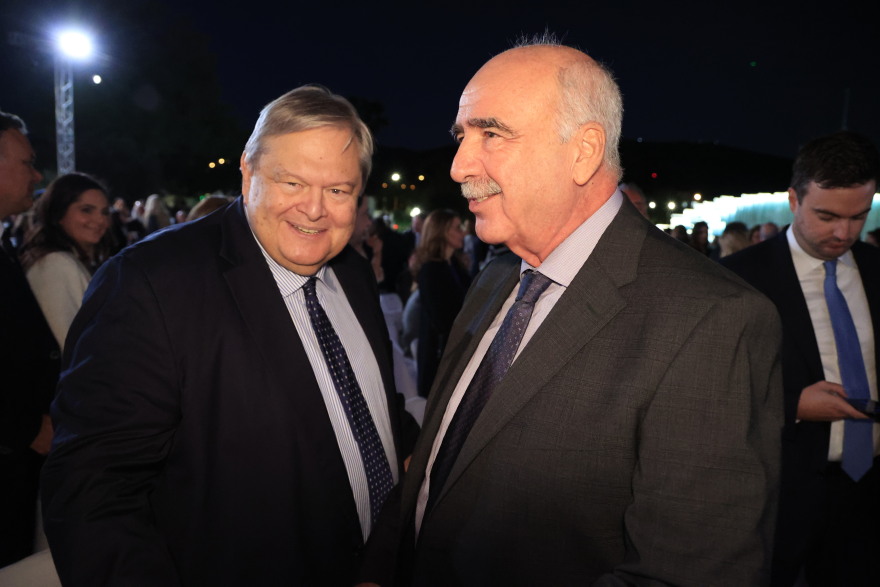
The unveiling ceremony takes place on Wednesday afternoon, in the presence of President of the Hellenic Republic Konstantinos Tasoulas, Prime Minister Kyriakos Mitsotakis, and Minister of National Defense Nikos Dendias.
The project bears the signature of internationally acclaimed sculptor and professor at the Aristotle University of Thessaloniki, Kostas Varotsos, and architectural engineer Chrysanthi Asproulopoulou. The two artists worked closely together to completely redesign the building’s façade, giving it a new identity that combines artistic expression, functionality, and energy efficiency.
The renovated building merges artistic creativity with environmental innovation, transforming what was once a strict and austere structure into a bright, modern, and dynamic construction.
A new era has begun for the Ministry of National Defence, as the new bioclimatic facade of its central building on Mesogeion Avenue is unveiled today.
The transformation of this historic building, originally constructed in the 1960s, marks a major advance in the field of architecture and environmental sustainability.
The unveiling ceremony will take place on Wednesday afternoon, in the presence of President of the Republic Konstantinos Tasoulas, Prime Minister Kyriakos Mitsotakis, and National Defence Minister Nikos Dendias.
More details about the renovation and future plans for the building are expected to be revealed at the event. The project is signed by the internationally acclaimed sculptor and professor of the Aristotle University of Thessaloniki, Kostas Varotsos, and the architect and engineer Chrysanthi Asproulopoulou. The two artists worked closely together to radically redesign the building’s façade, giving it a new identity that combines artistic expression with functionality and energy efficiency.
The remodeling work began months ago, focusing on initial interventions mainly in ancillary buildings, to culminate in a radical overhaul of the whole. The renovated building combines artistic expression with environmental innovation, transforming the once austere and cold structure into a bright and contemporary structure.
Attendees at the event will have the opportunity to view stunning images and videos highlighting the innovative approach to the renovation. Bioclimatic retrofitting promotes sustainability and is a model for future public projects.
Protest earlier outside the Ministry
Earlier, Federations and Associations of active and retired officers held a protest gathering at Armed Forces Square, across from the Ministry of National Defense, in reaction to the Ministry’s multi-bill.
Kimberly Guilfoyle, the new U.S. Ambassador to Greece, is scheduled to formally begin her duties next week after arriving in Athens, with her first public appearance expected to be at a nightclub.
From Ancient Oath to Modern Ethics: Honoring the Legacy of Hippocrates in the Birthplace of Medicine
Kos, Greece — October 12–19, 2025 The island of Kos, birthplace of Hippocrates, became the center of international medical dialogue during the 2025 International Hippocratic Foundation Week (I.H.F.K.), an annual tradition held in cooperation with the Global Doctors’ Hippocratic Institute (G.D.H.I.). Physicians, academics, and students from around the world gathered to celebrate medicine’s ethical roots while addressing the challenges of modern healthcare.
The event was led by Dr. Nikolaos Papantoniou, President of the I.H.F.K., and Dr. George Patoulis, President of G.D.H.I., the Athens Medical Association, and ELITOUR. The organizing committee included Prof. Dr. Stephanos Geroulanos, Dr. George Tallaros, Dr.Nikolaos Manousis, Dr.Antonios Polydorou, Dr.Philippos Kalloudis, Dr.Konstantinos Pantos, Dr.Konstantinos Kouskoukis, and Dr.Lillian Markak. Their shared goal: to connect Hippocratic values with today’s scientific and humanitarian priorities.
Mordechai or Mordechaios Frizis (January 1, 1893 - December 5, 1940) was a Greek Romaniote Jew, the first senior Greek officer who was killed fighting heroically in the Greco-Italian War. Mordechaios Frizis was born in 1893 in Chalkida to a large family. His dream was to become an officer. He took exams at the Evelpidon School but dropped out. There are two versions of this, a) that he considered it derogatory that he did not come first and b) that because of his Jewish religion he was not accepted [3]. He took exams at the University and succeeded in Law.
In the presence of the President of the Republic, Konstantinos Tasoulas, Prime Minister Kyriakos Mitsotakis, the Ministers of Defense of Greece and Cyprus, Nikos Dendias and Vassilis Palmas, the presidents of PASOK and SYRIZA, party representatives, members of parliament, the mayor of Thessaloniki and the leadership of the Armed Forces, this year's military parade is taking place in Thessaloniki.
A serious incident occurred on Monday night in Tyrnavos, Larissa, when a man who allegedly suffers from psychological problems threatened his family with a knife, raising an alarm to the authorities.
A religiouw memorial service-trisagio and wreath-laying ceremony in memory of the dead of the Greco-Italian War took place at the 3rd Army Corps in Thessaloniki, as part of the events for October 28.
The United Kingdom will sell Turkey 20 Eurofighter Typhoon fighter jets, with the agreement reaching 8 billion pounds, or approximately 9.1 billion euros.
What are Eurofighter Typhoon fighters?
The Eurofighter Typhoon is one of the most advanced 4.5 generation fighter aircraft, used by many NATO member countries, including the United Kingdom, Italy and Spain. It is a multi-role fighter with air superiority and strike capabilities, making it highly capable of meeting the modern demands of air warfare.
The Turkish Air Force has an aging fleet, with most of its aircraft being F-16s dating back to the 1980s, and the need for modernization is urgent.
Why Turkey wants the Eurofighter Turkey has been in a strategic impasse since it was excluded from the F-35 program due to the purchase of Russian S-400 missile systems, which has limited its air defense options. In the midst of this gap, the Eurofighter deal offers a temporary solution and strengthens its deterrent power, without being dependent on American aircraft.
Furthermore, Turkey sees the acquisition of the Eurofighter as a “bridge” to future, indigenous systems it is developing, such as the KAAN fighter. Its participation in this European consortium also offers the possibility of cooperation with Western industries and strengthens its position in the European and international defense technology market.
The benefits for the United Kingdom This deal is also extremely beneficial for the United Kingdom, which through the sale of the Eurofighter ensures the continuation of production of the aircraft and strengthens the viability of its defense industry. This deal could secure jobs and strengthen the export prospects of the British aerospace industry, while at the same time serving strategic objectives, strengthening defense ties with a key country in the region.
Turkey between the West, Russia and China Turkey’s acquisition of the Eurofighters also has significant geopolitical implications. Turkey remains a NATO member, and the choice of the Eurofighters, which are fully compatible with the Alliance’s systems, underlines its strategic integration into the Western camp, despite political tensions with other NATO and EU countries.
This agreement can also be seen as part of a broader strategic realignment in the region, where Turkey, while maintaining its relations with the West, is trying to balance the influence exerted by Russia and China. Europe, through strengthening defense relations with Turkey, seeks to secure the region from potential threats and strengthen NATO’s collective defense, in view of the ever-increasing pressures from the Russian factor.
Germany’s key role in Turkey’s Eurofighter deal One of the most contentious points of the deal is the need for Turkey to obtain approval from all partner countries in the Eurofighter consortium (the UK, Italy, Spain and Germany). Germany, which has stricter defense export policies, has previously objected to the sale of aircraft to third countries with politically and strategically controversial regimes. The final decision will depend on the political balances between the partners in the consortium, with Germany playing a central role in whether or not to approve the deal.
Impact on Greece and the Eastern Mediterranean The potential increase in Turkey’s defense capabilities with the Eurofighters reinforces the need for Greece and other countries in the region to renew their military capabilities and ensure their strong position in NATO and the Middle East.
It should be noted that Greece is considering the possibility of purchasing 8-12 more F-35s, in addition to the 20 that have already begun to be manufactured in the US for the Air Force. The first is estimated to be ready in 2028.
In parallel, Greece already has Rafale fighters, creating an air defense network that also includes the upcoming F-35 fighter aircraft.
In a global context where energy sovereignty is becoming a critical element of national security, the Foundation for Defense of Democracies (FDD) organized an event with the central theme “Powering U.S. Energy Dominance”, during which the US Secretary of the Interior and Head of the US Energy Sovereignty Council, Doug Bergham, gave an interview about the role of the United States in shaping a new international energy map and the importance of strategic alliances. In the context of this interview, Mr. Bergham referred extensively to Greece, extolling the leadership of Prime Minister Kyriakos Mitsotakis and our country’s role in Europe’s energy security.
An attack on New Democracy MP and former Minister Makis Voridis took place on Saturday night in a restaurant in Heraklion, Crete, when about 25 people wearing hoods and helmets began throwing eggs at him, cursing him and chanting slogans against him.